

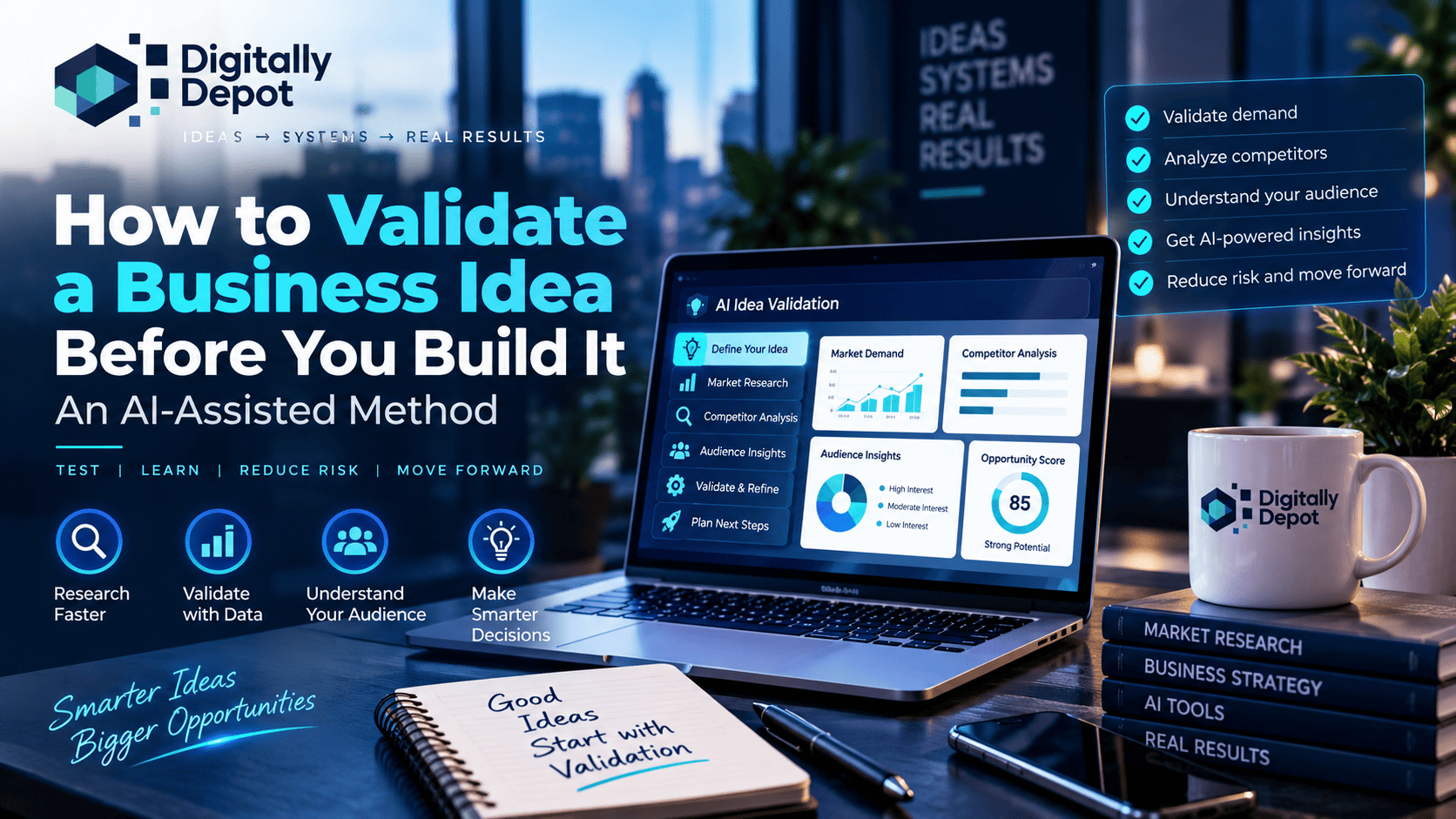
How to Validate a Business Idea Before You Build It: An AI-Assisted Method
A good idea is not the same as a validated business opportunity. Before you spend weeks building a product, website, course, app, or service, you need evidence that a real group of people has the problem you want to solve and cares enough to take action.
AI can make validation faster by helping you organize research, compare patterns, draft questions, and summarize what you learn. But the strongest validation still comes from real market behavior.
Start with a clear hypothesis
Write your idea as a simple statement:
This gives you something concrete to test. Avoid broad statements such as “people need better productivity.” A narrower hypothesis is easier to validate because you know who to talk to and what evidence to look for.
Step 1: Research the problem, not just the industry
Begin by looking for proof that the problem already exists. Useful sources include product reviews, public communities, search suggestions, social comments, competitor FAQs, support discussions, and customer interviews.
AI can help you summarize these sources into themes. For example, you can organize comments into categories such as frustration, desired outcome, current workaround, price concern, feature request, and buying trigger.
The goal is to identify repeated patterns. One complaint can be noise. The same complaint appearing across different sources is more meaningful.
Step 2: Study how people solve the problem today
If customers already spend time or money trying to solve the problem, that is useful evidence. Look at direct competitors, indirect alternatives, spreadsheets, manual workarounds, agencies, freelancers, software tools, templates, and free resources.
Ask:
- What are people using now?
- What do they like about existing solutions?
- What do they complain about?
- What feels too expensive, too complex, or incomplete?
- What result do customers actually care about?
AI can turn this research into a competitor matrix so you can compare positioning instead of relying on memory.
Step 3: Talk to potential customers
Customer conversations are most useful when you ask about real behavior instead of asking whether someone “likes” your idea.
Better questions include:
- When did you last deal with this problem?
- What did you do to solve it?
- What was frustrating about that process?
- What did it cost you in time, money, or missed opportunity?
- What would make a solution worth paying for?
AI can help you prepare interview questions and summarize notes afterward, but do not let it replace the actual conversation.
Step 4: Test the message before the product
Before building the full solution, test whether people understand and care about the promise. Create a simple landing page or offer that explains the audience, problem, desired outcome, and next step.
The next step might be joining a waitlist, requesting early access, booking a call, downloading a related resource, or purchasing a small initial version.
If people consistently misunderstand the offer, the problem may be positioning rather than the idea itself. Validation helps you discover that early.
Step 5: Build a minimum useful test
You do not need the final product to test demand. Depending on the idea, a useful minimum test could be:
- A short guide or template
- A manual version of a future automated service
- A paid workshop
- A small service package
- A prototype
- A limited early-access offer
The test should deliver enough value to measure real interest while keeping your time and cost low.
Step 6: Score the evidence
After collecting research, score the idea using a simple framework. Rate each area from 1 to 5:
- how often does the problem occur?
- how painful or costly is it?
- are people already paying for alternatives?
- can you find and communicate with the audience?
- can you offer a meaningful reason to choose your solution?
- can you build and deliver a useful version with your current resources?
This does not turn validation into a perfect formula. It gives you a disciplined way to compare ideas and decide what deserves more investment.
What counts as strong validation?
Strong validation is usually behavioral. Examples include people paying, joining a relevant waitlist, booking calls, repeatedly asking for the solution, completing a meaningful survey, using a prototype, or switching from an existing workaround.
Weak validation is mostly verbal enthusiasm with no action behind it. “That sounds cool” is encouraging, but it is not the same as demand.
Use AI as an analyst, not as the market
AI can help you move faster through research and synthesis, but it cannot prove that customers will buy. Treat it as a research assistant: use it to structure the process, surface patterns, and challenge assumptions. Then use real people and real behavior to validate the decision.
If you want a structured set of worksheets and workflows for moving from idea discovery through validation and launch, explore the practical resources in the Digitally Depot shop.
Make Your Business Online By The Best No—Code & No—Plugin Solution In The Market.
30 Day Money-Back Guarantee
Say goodbye to your low online sales rate!