

How to Start an Online Business With AI: A Practical 6-Step Framework
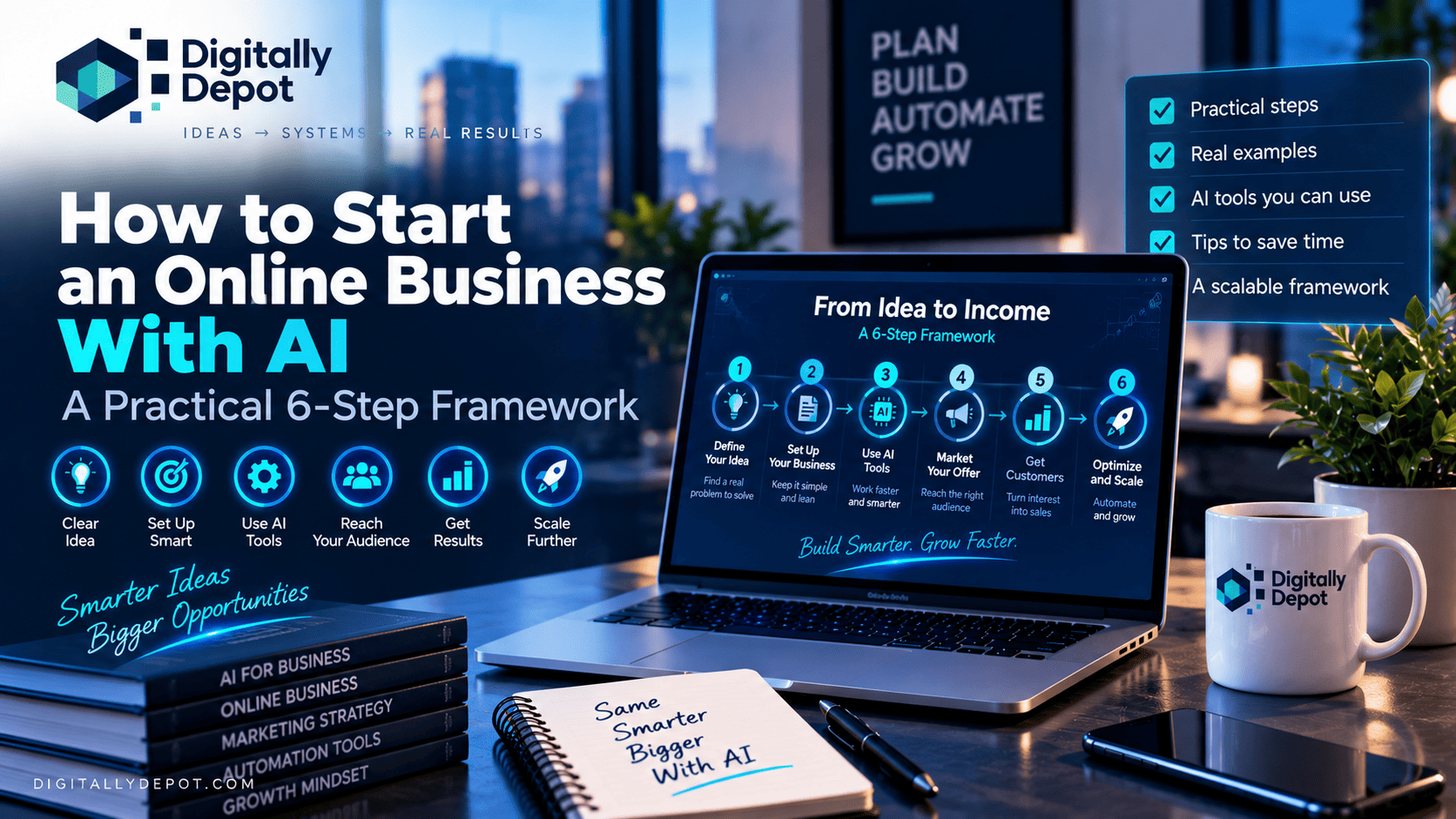
Starting an online business is easier than it used to be, but building one that is focused, useful, and sustainable still requires good decisions. AI can speed up research, planning, content creation, branding, and marketing, but it works best when you use it inside a clear process rather than treating it as a shortcut.
This practical framework breaks the process into six stages: . It is designed for solo entrepreneurs, creators, freelancers, and small business owners who want to move from idea to execution without getting buried in tools or information.
1. Discover: Start with a real problem
A strong business usually begins with a problem that a specific group of people already cares about. Instead of asking AI for random business ideas, give it context. Describe the audience you understand, the skills you already have, the industries you know, and the kinds of problems you enjoy solving.
Use AI to generate possibilities, then filter them using three questions:
- Is the problem painful or important enough that people actively look for a solution?
- Can I explain the value of my solution in one simple sentence?
- Can I realistically reach the people who have this problem?
The goal is not to find a perfect idea. It is to identify a useful problem worth validating.
2. Validate: Look for evidence before you build
One of the most expensive mistakes in online business is building too much before confirming demand. Validation reduces that risk.
You can use AI to organize competitor research, summarize customer reviews, identify repeated complaints, and turn raw notes into patterns. But the evidence should come from the market itself: search behavior, public conversations, competitor offers, customer comments, surveys, interviews, waitlists, or early sales.
A simple validation test can be a landing page, a short survey, a pre-launch offer, a free sample, or a conversation with potential customers. You are looking for behavior, not just compliments.
3. Build: Create the smallest useful version
Once the idea has evidence behind it, build the smallest version that solves the core problem. For a digital business, that might be a guide, template, toolkit, mini-course, service package, resource library, or simple software workflow.
AI can help you outline content, organize modules, draft examples, generate checklists, improve instructions, and find gaps. Keep human judgment in the loop. Your experience, examples, positioning, and quality control are what make the result useful instead of generic.
At this stage, focus on clarity. Your customer should understand what the product is, who it is for, what problem it solves, and what they can do with it after they buy.
4. Brand: Make the value easy to recognize
Branding is more than a logo. It is the consistent way your business looks, sounds, and explains its value. AI can help with naming directions, positioning statements, tone-of-voice guidelines, color concepts, product descriptions, and visual briefs.
Keep the brand system simple at first. Choose a clear promise, a small color palette, one or two fonts, a consistent visual style, and a recognizable tone. Consistency creates trust faster than complexity.
5. Launch: Build a focused path to purchase
A launch does not need dozens of channels. Choose one primary audience, one main offer, and a small number of ways to reach people.
Your launch system can include:
- A clear product or landing page
- Three to five educational posts around the problem you solve
- An email sequence for interested visitors
- A simple call to action
- A way to collect questions and feedback
AI can help you adapt one core message into emails, social posts, FAQs, short videos, and ad concepts. The key is to keep the message consistent instead of generating unrelated content for every platform.
6. Grow: Improve the system, not just the workload
After launch, growth should come from learning. Track which pages people visit, which messages get clicks, which questions appear repeatedly, and where customers hesitate.
Use those signals to improve the offer, the page, the content, and the workflow. AI is especially useful here because it can summarize feedback, categorize support questions, repurpose strong content, and help you document repeatable processes.
The goal is to create a business that becomes easier to operate as it grows, not one that creates more manual work every week.
A simple rule for using AI in business
Use AI to accelerate thinking and execution, but keep strategy, judgment, customer understanding, and quality control in human hands. The best results come from combining speed with a clear process.
If you want a structured system for moving through these six stages, explore the practical resources available in the Digitally Depot shop, including the AI Business Launch Kit.
Make Your Business Online By The Best No—Code & No—Plugin Solution In The Market.
30 Day Money-Back Guarantee
Say goodbye to your low online sales rate!
Can AI help me start an online business from scratch?
Yes. AI can support research, planning, writing, branding, marketing, and workflow design, but you should still validate the idea with real market evidence and review the output for quality.
What should I validate before building a product?
Validate the customer problem, the target audience, existing alternatives, willingness to act or pay, and whether you have a realistic way to reach potential customers.
Do I need many AI tools to get started?
No. A simple workflow with one capable AI assistant plus your website, email, and basic analytics is enough for many early-stage businesses.