


36 AI Workflow Ideas for Small Business: Save Time Without Losing Quality
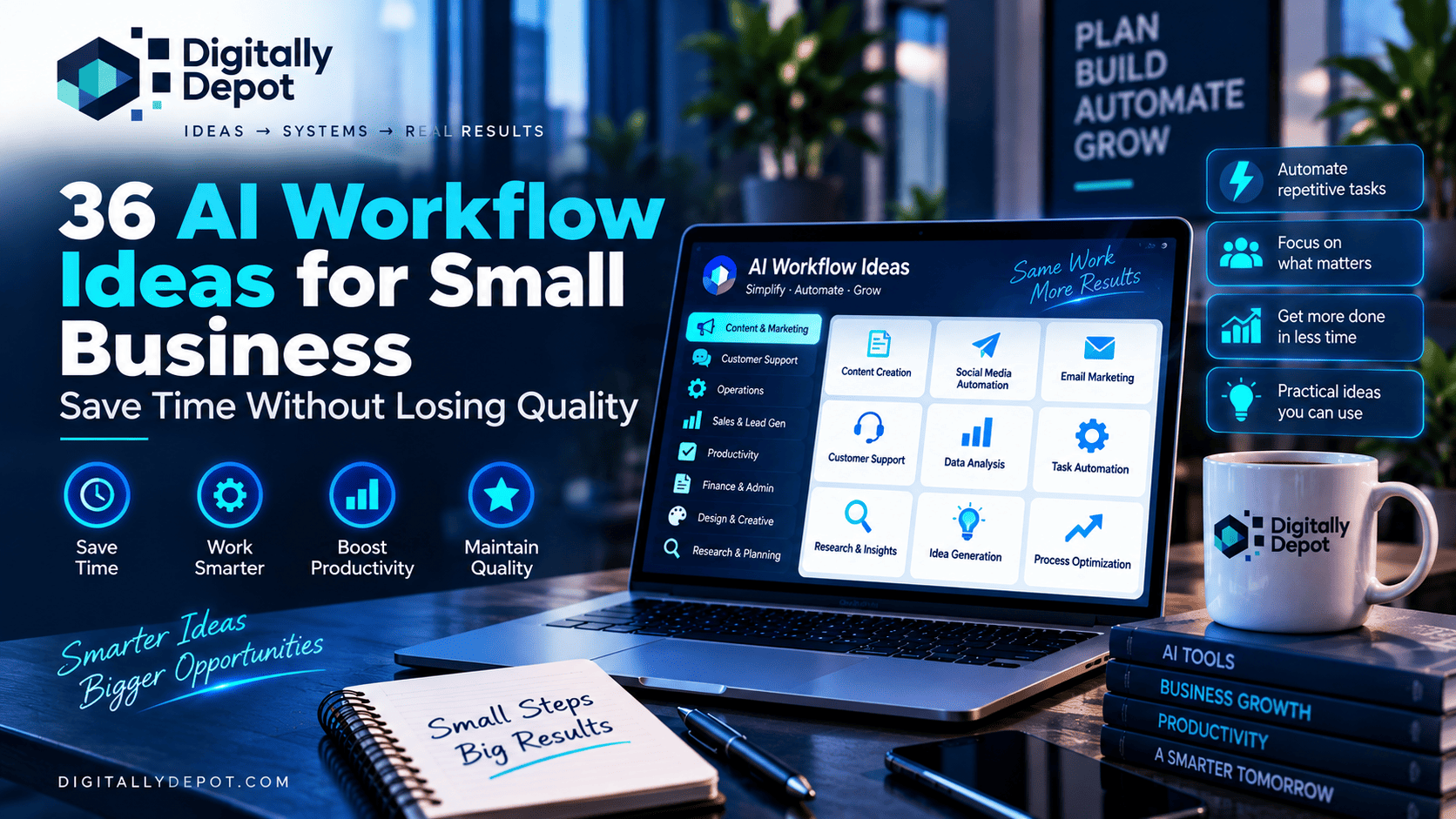
AI is most valuable in a small business when it becomes part of a repeatable workflow. The goal is not to automate everything. It is to remove repetitive work, speed up first drafts, organize information, and make it easier to move from an idea to a finished result.
Below are 36 practical AI workflow ideas you can adapt for a digital business, service business, ecommerce brand, freelance operation, or creator-led company.
Research and idea development
- Summarize recurring complaints from reviews, forums, support tickets, or survey responses.
- Organize competitors by audience, promise, pricing, strengths, and gaps.
- Turn a list of customer problems into possible products, services, lead magnets, or bundles.
- Create interview and survey questions designed to test assumptions instead of asking for compliments.
- Convert an industry trend into practical business opportunities while separating short-term hype from lasting demand.
- Rate ideas using demand, reachability, differentiation, cost, complexity, and speed to market.
Product and service creation
- Transform a customer outcome into modules, steps, templates, or deliverables.
- Review a draft and identify missing explanations, examples, edge cases, or instructions.
- Create reusable checklists, worksheets, scripts, SOPs, and client questionnaires.
- Generate realistic examples for guides, training materials, or onboarding documents.
- Turn product details and common objections into a structured FAQ section.
- Check tone, clarity, duplication, confusing language, and unsupported claims before publishing.
Branding and positioning
- Summarize who the offer is for, what it helps them achieve, and why it is different.
- Build a main promise, supporting benefits, proof points, and calls to action.
- Define tone, vocabulary, sentence style, phrases to use, and phrases to avoid.
- Generate naming directions based on positioning rather than random word combinations.
- Convert brand strategy into instructions for a designer or image generator.
- Compare several pages or campaigns and flag inconsistent terminology or messaging.
Content and marketing
- Turn one keyword or customer question into an outline with search intent, sections, examples, and CTA.
- Convert one long article into social posts, email ideas, short scripts, and FAQ content.
- Create welcome, education, launch, cart, or follow-up sequences from a single offer brief.
- Adapt one core message for different platforms without changing the central promise.
- Create several opening angles for a post or video, then select the one that best matches the audience.
- Rewrite weak calls to action so they are specific, useful, and aligned with the next step.
Sales and customer experience
- Summarize inquiry details and categorize prospects by fit, urgency, and next step.
- Turn discovery notes into a structured proposal with scope, outcomes, timeline, and assumptions.
- Collect recurring objections and create clear, non-pushy responses for each one.
- Draft answers using approved policies and product information for human review.
- Group customer comments into product issues, questions, praise, feature requests, and confusion points.
- Analyze customer reviews to identify which benefits customers value most.
Operations and productivity
- Convert notes into decisions, owners, deadlines, and follow-up tasks.
- Turn an informal process into a repeatable standard operating procedure.
- Prioritize tasks based on impact, urgency, dependencies, and available time.
- Rewrite complex internal instructions into clear steps without changing the meaning.
- Turn spreadsheet observations, analytics notes, or campaign metrics into a short decision-focused summary.
- Identify repetitive tasks, bottlenecks, handoff problems, and possible automation opportunities.
How to turn an AI prompt into a real workflow
A useful workflow should have five parts. For example, a blog workflow might start with a customer question, use a structured prompt to create an outline, require examples and a specific tone, include a human fact-check, and finish with an SEO-ready draft.
This structure matters because random prompting produces inconsistent results. Repeatable workflows make it easier to maintain quality as your business grows.
Start small
Choose two or three workflows that remove a real bottleneck this week. Document what goes in, what AI should do, what you must review, and what the final output should look like. Once the process works reliably, repeat it or automate parts of it.
For a ready-to-use collection of practical business workflows, explore the resources in the Digitally Depot shop, including the AI Business Launch Kit and its 36 AI workflows.
Make Your Business Online By The Best No—Code & No—Plugin Solution In The Market.
30 Day Money-Back Guarantee
Say goodbye to your low online sales rate!